Play Sudoku Online
About Sudoku
Sudoku is a logic puzzle played on a 9×9 grid divided into nine 3×3 boxes. The goal is simple to state and endlessly satisfying to chase: fill every cell so each row, column, and box contains the digits 1 through 9 exactly once. No guessing or arithmetic is required: every puzzle on this page can be solved through pure deduction, working out which digits are forced into which cells by the numbers already on the board.
Every Sudoku here is generated fresh from a random seed, building a full solved grid and then carving clues out of it while checking after every removal that the puzzle still has exactly one solution, so no guessing is ever required, only deduction. Pick a difficulty above to start a new puzzle, or come back any time for another one: the seed in the page's URL means you can bookmark or share a specific puzzle and return to that exact grid later.
The four difficulties on this page don't change the rules, only how much a puzzle tells you up front: Easy boards leave enough digits that a first pass of eliminating candidates already fills most of the grid, while Expert boards remove clues down near the floor a unique grid can tolerate, so early moves come from chains of several compatible cells rather than any single obvious placement. The deeper the difficulty, the more you'll lean on scanning a box, row, and column together instead of any one of them alone.
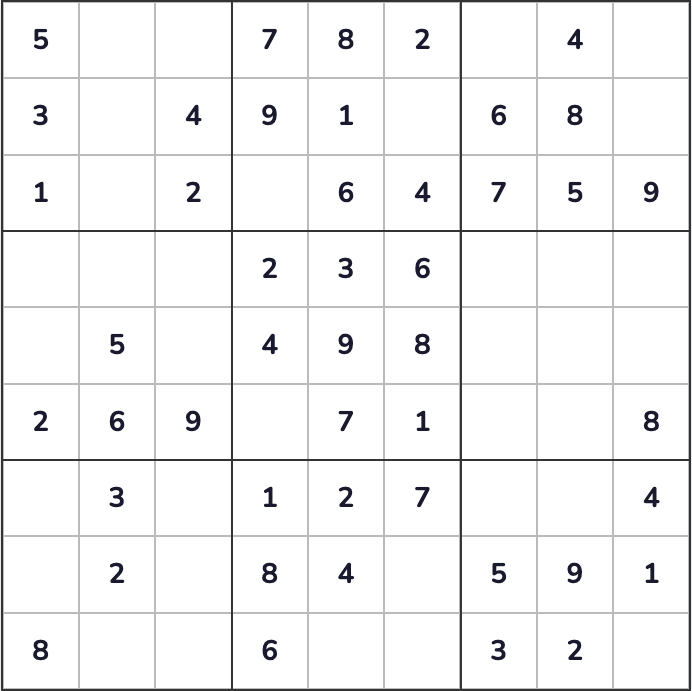
How to play Sudoku
- Fill the 9×9 grid so that every row, every column, and every 3×3 box contains the digits 1–9 exactly once: no digit may repeat within any of those three groups.
- Cells shown filled in when the puzzle starts are fixed clues and can't be changed; only the blank cells need to be solved.
- Look for cells where only one digit can legally go: a row, column, or box that's already missing just one number is the easiest place to start. As you fill in more cells, more of these forced moves appear.
- Notes (pencil marks) let you jot down candidate digits in a cell without committing to one, which is useful once the easy deductions run out and you need to track possibilities across a row or box.
- The puzzle is solved the moment every cell holds a valid digit; there's no separate "submit" step.
Controls (touchscreen)
- Tap a cell to select it: if it holds a digit, every other cell holding that same digit is highlighted to make conflicts easy to spot.
- Tap a number on the on-screen pad to place it in the selected cell.
- Tap the Notes toggle to switch to pencil-mark mode, so tapping a number adds it as a small candidate mark instead of a final answer; tap the toggle again to return to normal entry.
- Tap Erase to clear whatever is in the selected cell, whether it's a final digit or a set of notes.
- Tap Undo to step back through your recent moves one at a time.
Controls (PC)
- Click a blank cell to select it.
- 1-9Type any digit 1–9 to fill it in directly from the keyboard.
- 0BackspaceDeletePress 0, Backspace, or Delete to clear the selected cell.
- SpacePress Space to toggle Notes (pencil-mark) mode on or off for subsequent keypresses.
- CtrlZPress Ctrl+Z (or Cmd+Z on Mac) to undo your last move.
- Arrow keysUse the Arrow keys to move the selection to an adjacent cell without reaching for the mouse.
Every Sudoku puzzle is fair
A cell only stays empty on this page once Sudoku's generator has run its own solver and found that no other digit could sit there: uniqueness isn't assumed from a clue count, it's proven fresh for every seed before the puzzle ships. That proof is exactly why every difficulty here can be finished by deduction alone, with the clue count only changing how long a chain of forced moves needs to run.
Two checks work together to keep that guarantee affordable: countSolutions, capped at two solutions, confirms the finished grid once, while the cheaper hasSolutionAvoiding runs inside the dig loop itself, asking only whether the cell just emptied could take a second digit. Easy stops at 46 clues and Expert at 31: floors the dig loop respects but sometimes overshoots, since it will never trade away uniqueness just to hit a target count.