Play Killer Sudoku Online
About Killer Sudoku
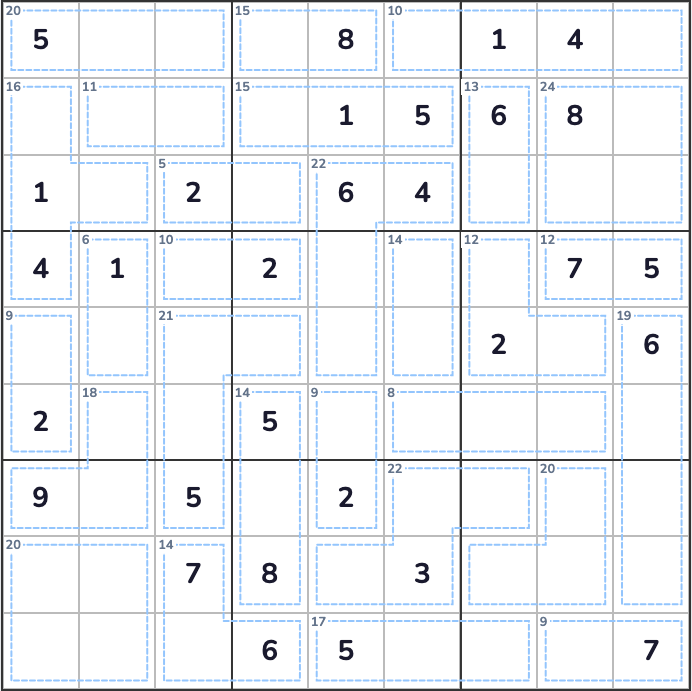
Killer Sudoku takes the familiar 9×9 Sudoku grid and swaps most of its starting digits for arithmetic. Every row, column, and 3×3 box still needs the digits 1–9 exactly once, but the extra structure comes from dashed “cages”: groups of cells, each labelled with a target sum that its digits must add up to, with no digit repeated inside the cage.
Because the cages do the work that given digits normally do, the higher difficulties can start with very few clues, or none at all. Every board here is generated fresh from a random seed and is guaranteed to have exactly one solution, so no guessing is ever required. The seed lives in the page URL, so you can bookmark or share a specific puzzle. Pick a difficulty above to begin.
Because cages carry so much of the puzzle’s information, difficulty here comes from how much you can infer from a sum before you ever place a digit: a two-cell cage summing to 4 can only be {1,3}, but a five-cell cage summing to 20 admits far more combinations, and the higher difficulties lean on exactly that gap: fewer starting digits, but cages arranged so their sums still narrow the possibilities enough to get moving.
How to play Killer Sudoku
- Fill the grid so every row, every column, and every 3×3 box contains the digits 1–9 exactly once: no digit may repeat within any of those three groups.
- The grid is partitioned into dashed cages, each showing a small target sum in its top-left cell. The digits inside a cage must add up to that sum exactly, and (like a row or box) a cage may not contain the same digit twice.
- Any given digits are fixed clues. Easy and Normal boards start with several; Hard starts with only a handful; Expert starts with none, leaving the cage sums to determine everything.
- Notes (pencil marks) let you record candidate digits in a cell without committing, which is essential on cage-heavy boards where you track combinations that add to a sum.
- The puzzle is solved the moment every cell holds a valid digit with no row, column, box, or cage broken; there is no separate submit step.
Controls (touchscreen)
- Tap a blank cell to select it.
- Tap a number on the on-screen pad to place it in the selected cell.
- Tap the Notes toggle to switch to pencil-mark mode, so tapping a number adds it as a small candidate mark instead of a final answer; tap again to return to normal entry.
- Tap Erase to clear whatever is in the selected cell.
- Tap Undo to step back through your recent moves one at a time.
Controls (PC)
- Click a blank cell to select it.
- 1-9Type any digit 1–9 to fill it in directly from the keyboard.
- 0BackspaceDeletePress 0, Backspace, or Delete to clear the selected cell.
- SpacePress Space to toggle Notes (pencil-mark) mode for subsequent keypresses.
- CtrlZPress Ctrl+Z (or Cmd+Z on Mac) to undo your last move.
- Arrow keysUse the Arrow keys to move the selection to an adjacent cell.
Every Killer Sudoku puzzle is fair
Killer Sudoku hands the uniqueness proof over to cage sums as soon as the digit count allows it: Expert boards aim to clear every leftover digit and let the cages alone carry the weight. Before any of that ships, the generator’s solver has to come up empty hunting for a different grid the same cage sums would also satisfy; a cage’s target is never decorative here, it’s load-bearing for whether the board counts as solved.
Cage size is the other difficulty lever: Easy and Normal keep every cage to 2–4 cells, while Hard and Expert allow cages up to 5 cells, and the given-count floor drops from 30 on Easy to 18, then 8, then all the way to 0 on Expert. None of those floors is a promise the dig loop rushes toward: it only stops emptying cells once no further removal would still leave the board provably unique.