Play Kakuro Online
About Kakuro
Kakuro is sometimes described as a crossword built from arithmetic instead of words. Black clue cells mark the sums for runs of white cells that cross the grid horizontally and vertically; your job is to fill every white cell with a digit from 1–9 so each run's digits are all different and add up to its clue.
The combination of "no repeated digits" and "must hit an exact sum" usually narrows a run down to just a handful of possible digit sets, and cross-referencing where runs overlap is what cracks the rest of the grid open. Pick a difficulty above to start a new puzzle.
Run length, not black-cell density, is what actually drives difficulty here: a run capped at 4 cells only ever admits a small handful of digit combinations, so Easy boards crack open fast once you spot which sums are the most restrictive, while Master's runs of up to 8 cells leave many more combinations legal until you've cross-referenced several overlapping runs at once. A denser grid of black cells doesn't necessarily mean a harder puzzle (Easy actually packs in more black cells than Medium does); it's the length of the runs between them that decides how much cross-referencing a solve takes.
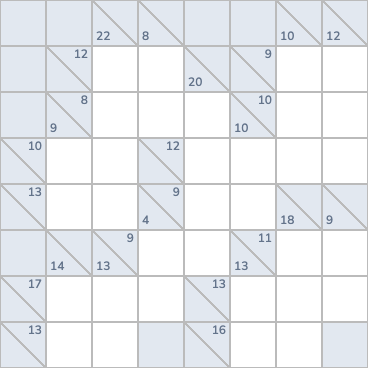
How to play Kakuro
- Every white run of cells (reading across or down) must be filled with digits 1–9 that add up to the clue number shown at the start of that run.
- No digit may repeat within the same run, which is the constraint that turns a sum into a small, specific set of possible digit combinations rather than endless options.
- Clue cells that border both an across run and a down run are split diagonally, showing the across sum in the top-right and the down sum in the bottom-left; a cell with only one number printed has only that single direction's run.
- Start with short runs and extreme sums: a 2-cell run summing to 3 can only be {1,2}, and a 2-cell run summing to 17 can only be {8,9}. Those near-forced runs are usually the fastest way into a new grid.
- The puzzle is solved once every white cell is filled and every run's digits are distinct and add up to its clue.
Controls (touchscreen)
- Tap a white cell to select it.
- Tap a number on the on-screen pad to place it in the selected cell.
- Tap the Notes toggle to switch to pencil-mark mode, so taps add small candidate digits instead of a final answer; tap again to return to normal entry.
- Tap Erase to clear the selected cell.
- Tap Undo to revert your most recent move.
Controls (PC)
- Click a white cell to select it.
- 1-9Type any digit 1–9 to fill it in.
- 0BackspaceDeletePress 0, Backspace, or Delete to clear the selected cell.
- SpacePress Space to toggle Notes (pencil-mark) mode for subsequent keypresses.
- CtrlZPress Ctrl+Z (or Cmd+Z on Mac) to undo your last move.
- Arrow keysUse the Arrow keys to jump to the nearest white cell in that direction, skipping over black clue cells.
Every Kakuro puzzle is fair
Kakuro's win check never compares your grid to the one the generator filled in first: it only checks that every run's digits are distinct and add up to its clue, so any filling that satisfies every sum legitimately wins, even if it differs from the generator's own solution. There's no solver proving a single answer here; the clue sums themselves are simply read off whatever valid grid the generator happened to build.
When a fill attempt dead-ends entirely, the whole grid is wiped and retried from scratch rather than patched (up to 40 times), and a per-restart cap on how many backtracking steps any one attempt can take keeps a runaway retry from stalling generation altogether.