Play Calcudoku Online
About Calcudoku
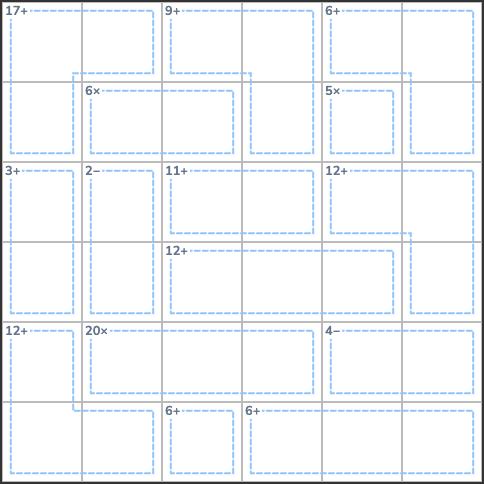
Calcudoku (also known as KenKen) strips a Latin square down to its essentials: every row and every column must hold each number exactly once, but there are no 3×3 boxes and almost no starting digits. Instead, the grid is carved into dashed “cages”, each labelled with a target number and an operation: add, subtract, multiply, or divide. The digits inside a cage must combine with that operation to reach the target, and unlike a row or column, a cage may repeat a digit as long as the repeats don’t land in the same row or column.
Every board here is generated fresh from a random seed and is checked to have exactly one solution, so no guessing is ever required. The seed lives in the page URL, so you can bookmark or share a specific puzzle. Pick a size above to begin: smaller grids are gentler on the arithmetic, larger ones give you more cages to juggle at once.
Because there are no boxes here, the operation printed on each cage carries more of the puzzle’s structure than it would in a boxed variant: a division cage narrows its two cells to one of a small number of factor pairs almost immediately, while a four-cell addition cage stays open until several other cells are already fixed. Bigger grids don’t just add more cages, they add more of that slower kind, so the reasoning shifts from spotting quick arithmetic locks toward carrying partial cage possibilities across the whole board.
How to play Calcudoku
- Fill the grid so every row and every column contains each number from 1 up to the grid size exactly once: no boxes, just rows and columns.
- The grid is partitioned into dashed cages, each showing a target number and an operation symbol (+, −, ×, ÷) in its top-left cell. The digits inside a cage must combine using that operation to produce the target exactly.
- A cage may contain the same digit more than once, provided the repeats never share a row or column: that restriction is already enforced by the Latin-square rule, so cages are freer than rows, columns, or Sudoku boxes.
- For subtraction and division cages (always exactly two cells), the operation is applied largest-first: the smaller digit is subtracted from, or divided into, the larger one.
- Notes (pencil marks) let you record candidate digits in a cell without committing, which helps while you work out which combinations satisfy a cage’s target.
- The puzzle is solved the moment every cell holds a valid digit with no row, column, or cage rule broken; there is no separate submit step.
Controls (touchscreen)
- Tap a blank cell to select it.
- Tap a number on the on-screen pad to place it in the selected cell.
- Tap the Notes toggle to switch to pencil-mark mode, so tapping a number adds it as a small candidate mark instead of a final answer; tap again to return to normal entry.
- Tap Erase to clear whatever is in the selected cell.
- Tap Undo to step back through your recent moves one at a time.
Controls (PC)
- Click a blank cell to select it.
- 1-9Type any valid digit to fill it in directly from the keyboard.
- 0BackspaceDeletePress 0, Backspace, or Delete to clear the selected cell.
- SpacePress Space to toggle Notes (pencil-mark) mode for subsequent keypresses.
- CtrlZPress Ctrl+Z (or Cmd+Z on Mac) to undo your last move.
- Arrow keysUse the Arrow keys to move the selection to an adjacent cell.
Every Calcudoku puzzle is fair
Every Calcudoku size on this page digs toward zero starting digits, so the cage operations alone are pinning the grid down. The generator only accepts that outcome once it has checked, and failed to find, any other Latin square the same set of cages could equally describe. The arithmetic is the entire proof of the board, not a hint layered on top of one.
Cage size stays fixed at 2–3 cells across every grid on this page, so difficulty comes entirely from how many cages a bigger board needs, never from any single cage growing harder to read. Division and subtraction are only ever handed to two-cell cages, and division only when the pair actually divides evenly, which is why a lone two-cell cage is often the fastest read on the whole board, whatever the size.