Play Skyscrapers Online
About Skyscrapers
Skyscrapers takes the plain Latin square (every row and every column holding each number exactly once) and turns the numbers into building heights viewed from outside the grid. Around the edges sit clue numbers: each one tells you how many buildings are visible looking straight along that row or column from that side, given that a taller building always hides every shorter one standing behind it.
Every board here is generated fresh from a random seed and is checked to have exactly one solution, so no guessing is ever required. The seed lives in the page URL, so you can bookmark or share a specific puzzle. Pick a size above to begin: smaller grids keep the sightlines short, larger ones give the visibility clues far more to say.
The visibility clues are what change character across sizes: on a 4×4 board a clue of 1 or 4 is nearly a giveaway, since only one arrangement of heights produces that extreme, but on a 7×7 board those extreme clues still help while a run-of-the-mill middle count like 3 leaves several tall-short orderings in play until neighbouring clues rule the rest out. Reading a sightline is never just about the number on the edge: it’s about how many height orders that number can possibly hide.
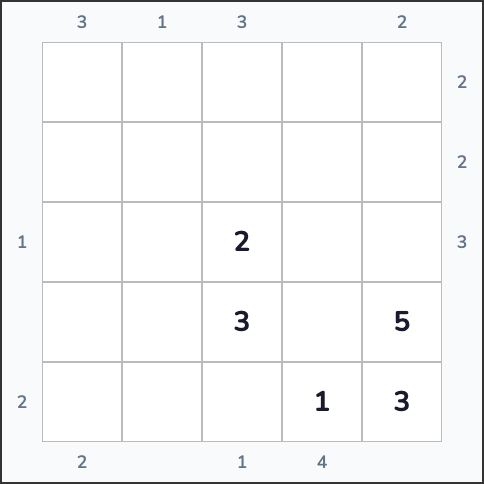
How to play Skyscrapers
- Fill the grid so every row and every column contains each height from 1 up to the grid size exactly once: no boxes, just rows and columns.
- Each clue number sitting outside the grid, on the edge of a row or column, counts how many buildings are visible looking down that line from that edge.
- A building only counts as visible if it is taller than every building standing between it and that edge: a tall building at the front hides everything shorter behind it, so the count is never higher than the number of buildings that are each a new tallest-so-far.
- A clue of 1 means the tallest building in that line stands right at that edge; a clue equal to the grid size means the heights climb in strict order all the way across, from shortest at that edge to tallest at the far end.
- Notes (pencil marks) let you record candidate heights in a cell without committing, which helps while you work out which arrangement satisfies every clue at once.
- The puzzle is solved the moment every cell holds a valid height with no row, column, or edge clue broken; there is no separate submit step.
Controls (touchscreen)
- Tap a blank cell to select it.
- Tap a number on the on-screen pad to place it in the selected cell.
- Tap the Notes toggle to switch to pencil-mark mode, so tapping a number adds it as a small candidate mark instead of a final answer; tap again to return to normal entry.
- Tap Erase to clear whatever is in the selected cell.
- Tap Undo to step back through your recent moves one at a time.
Controls (PC)
- Click a blank cell to select it.
- 1-7Type any valid height to fill it in directly from the keyboard.
- 0BackspaceDeletePress 0, Backspace, or Delete to clear the selected cell.
- SpacePress Space to toggle Notes (pencil-mark) mode for subsequent keypresses.
- CtrlZPress Ctrl+Z (or Cmd+Z on Mac) to undo your last move.
- Arrow keysUse the Arrow keys to move the selection to an adjacent cell.
Every Skyscrapers puzzle is fair
Skyscrapers asks its edge-clue counts to carry what a Sudoku box normally would, and the generator holds them to the same bar: a height only leaves the grid once the solver has checked that no other skyline could produce the same visible-building counts from every side. A sightline number is never approximate here: it is exactly as many buildings as that one arrangement allows, proven rather than eyeballed.
A visibility number isn’t chosen and then matched to a height order. It’s the reverse: the generator counts how many heights form an increasing run when read inward from an edge, and that count becomes the clue. Given-count floors sit low at every size precisely because that readout is so informative on its own; the dig loop only stops once no floor-respecting removal would still leave the grid provably unique.