Play Killer Arrows Online
About Killer Arrows
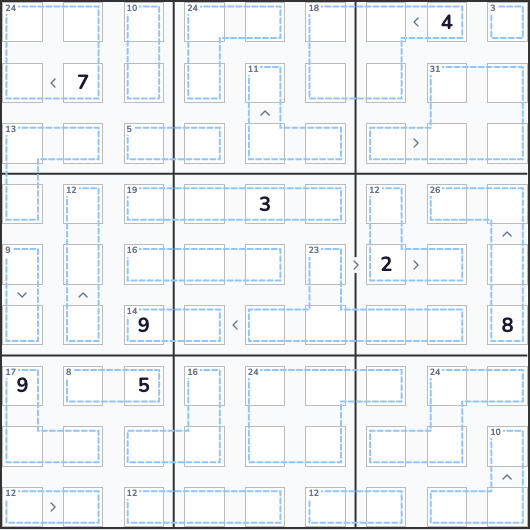
Killer Arrows is an original hybrid: it layers three logic-puzzle rule systems onto one 9×9 grid. Underneath it all sits ordinary Sudoku, where each row, column, and box holds the digits 1 through 9 without a repeat. Killer Sudoku contributes dashed “cages” on top of that (clusters of cells whose digits must add up to a printed total with none repeating inside the group), and Futoshiki threads “greater-than” arrows between some neighbouring pairs, marking which of the two must be larger.
Because the cages and arrows both narrow the grid down the way given digits normally would, the harder difficulties can open with only a handful of clues, or none at all. Boards here regenerate from a fresh random seed every time and always carry exactly one valid solution, so nothing on this page is ever solved by trial and error. Bookmark or share a puzzle straight from its URL (the seed travels with the link), and pick a difficulty above whenever you're ready to begin.
The three rule systems here don't contribute equally at every difficulty: on Easy, the leftover given digits do most of the early work and the cages and arrows mostly confirm what's already forced, while on Hard and Expert the arrows start ruling out digits before a cage sum can, and cage arithmetic often has to narrow a group before an arrow's direction becomes useful at all. Learning which rule to reach for first, cage or arrow, is most of what separates the higher difficulties from the lower ones.
How to play Killer Arrows
- Fill the grid so every row, every column, and every 3×3 box contains the digits 1–9 exactly once: no digit may repeat within any of those three groups.
- The grid is partitioned into dashed cages, each showing a small target sum in its top-left cell. The digits inside a cage must add up to that sum exactly, and (like a row or box) a cage may not contain the same digit twice.
- Some neighbouring cells are joined by a “greater-than” sign. The digit on the wide (open) side of the sign must be larger than the digit on the pointed side. A sign is satisfied only when both cells are filled and the order is correct.
- Any given digits are fixed clues. Easy and Normal boards start with several; Hard starts with only a handful; Expert starts with none, leaving the cages and arrows to determine everything.
- Notes (pencil marks) let you record candidate digits in a cell without committing, which is essential on boards this constrained, where you track combinations that satisfy a cage sum and an arrow at the same time.
- The puzzle is solved the moment every cell holds a valid digit with no row, column, box, cage, or arrow broken; there is no separate submit step.
Controls (touchscreen)
- Tap a blank cell to select it.
- Tap a number on the on-screen pad to place it in the selected cell.
- Tap the Notes toggle to switch to pencil-mark mode, so tapping a number adds it as a small candidate mark instead of a final answer; tap again to return to normal entry.
- Tap Erase to clear whatever is in the selected cell.
- Tap Undo to step back through your recent moves one at a time.
Controls (PC)
- Click a blank cell to select it.
- 1-9Type any digit 1–9 to fill it in directly from the keyboard.
- 0BackspaceDeletePress 0, Backspace, or Delete to clear the selected cell.
- SpacePress Space to toggle Notes (pencil-mark) mode for subsequent keypresses.
- CtrlZPress Ctrl+Z (or Cmd+Z on Mac) to undo your last move.
- Arrow keysUse the Arrow keys to move the selection to an adjacent cell.
Every Killer Arrows puzzle is fair
Killer Arrows layers three clue systems and proves uniqueness against all of them together: a digit clears the grid only after the solver confirms no other arrangement satisfies the surviving box rule, cage sums, and inequality arrows at once. Even at Expert, where every starting digit is gone, that three-way check is what stands between the board and a second valid answer, and it always comes back empty before a puzzle ships.
The given-count floor falls the same way Killer Sudoku’s does, from 30 on Easy down to 0 on Expert, while the arrow count climbs from 8 to 14 over that same span, so the harder difficulties trade away digits exactly as they hand the arrows more of the load to carry. Both cages and arrows come straight from the same finished grid, never adjusted afterward just to make a difficulty feel harder without removing real information.