Play Skyline Online
About Skyline
Skyline is a PuzzIt original: a hybrid that layers two classic logic-puzzle rule sets on the same Latin square. On an N×N grid you place the numbers 1 to N so each appears exactly once in every row and every column, exactly like Futoshiki and Skyscrapers individually. What makes Skyline different is that BOTH clue systems sit on the board at once: some neighbouring cells carry a Futoshiki-style “greater-than” sign the two numbers must obey, and the edges carry Skyscrapers-style visibility numbers counting how many buildings you’d see looking down that row or column, given that a taller building always hides every shorter one behind it.
Every board here is generated fresh from a random seed and is checked to have exactly one solution, so no guessing is ever required: each move follows from the rows, columns, inequality signs, and visibility clues already on the board. The seed lives in the page URL, so you can bookmark or share a specific puzzle and return to the exact same grid later. Pick a size above to begin: smaller grids keep both clue systems light, larger ones give each far more to say.
What makes Skyline distinct from either parent puzzle is how its two clue systems interact rather than simply stack: an inequality sign can rule out a height a visibility count couldn’t reach on its own, and a visibility count can turn an otherwise-symmetric inequality chain into a forced order. Larger sizes don’t just add more of each clue type: they add more places where the two kinds of reasoning have to be combined in the same line before anything moves.
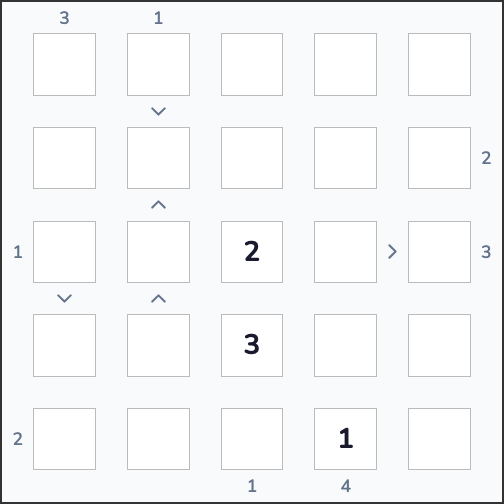
How to play Skyline
- Fill every cell so each row and each column contains the numbers 1 to N exactly once, where N is the grid size (4, 5, 6, or 7): a Latin square, no boxes.
- Between some adjacent cells sits a “greater-than” sign. The number in the cell on the open (wide) side of the sign must be larger than the number in the cell on the pointed side.
- Each clue number sitting outside an edge counts how many buildings are visible looking down that row or column from that side: a building only counts as visible if it is taller than every building standing between it and that edge.
- A few cells start with a fixed number to anchor the puzzle; the rest are deduced from the inequality signs, the visibility clues, and the Latin-square rule working together.
- Notes (pencil marks) let you record candidate numbers in a cell without committing, which helps once the direct deductions from one clue system run out and you need to cross-reference the other.
- The puzzle is solved the moment every cell holds a valid number with no row, column, inequality sign, or visibility clue broken; there is no separate submit step.
Controls (touchscreen)
- Tap a blank cell to select it.
- Tap a number on the on-screen pad to place it in the selected cell.
- Tap the Notes toggle to switch to pencil-mark mode, so tapping a number adds it as a small candidate mark instead of a final answer; tap again to return to normal entry.
- Tap Erase to clear whatever is in the selected cell.
- Tap Undo to step back through your recent moves one at a time.
Controls (PC)
- Click a blank cell to select it.
- 1-7Type any valid height to fill it in directly from the keyboard.
- 0BackspaceDeletePress 0, Backspace, or Delete to clear the selected cell.
- SpacePress Space to toggle Notes (pencil-mark) mode for subsequent keypresses.
- CtrlZPress Ctrl+Z (or Cmd+Z on Mac) to undo your last move.
- Arrow keysUse the Arrow keys to move the selection to an adjacent cell.
Every Skyline puzzle is fair
Skyline checks its uniqueness across both rule sets at the same time rather than one after the other: clearing a height fails unless the solver can rule out every arrangement the surviving inequality signs and visibility counts could jointly still satisfy. Stacking two clue systems on one board never opens a second way to finish it; the proof simply has twice as many clue types to account for at once.
Skyline draws its inequality signs and its visibility numbers from the same finished grid rather than bolting two independent boards together, which is what lets the two systems’ consequences interact instead of merely coexist. Because both clue floors sit low at every size, even an Easy Skyline board leans on real deduction from both rule sets: it’s never simply an easy Futoshiki with visibility numbers glued on top.