Play Slitherlink Online
About Slitherlink
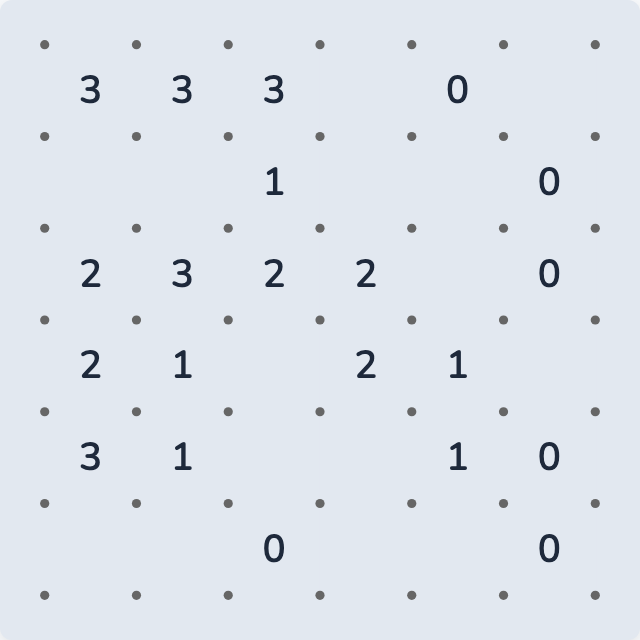
Slitherlink is a loop-drawing logic puzzle: you trace one closed line along the dots of a grid, and that single loop can never branch, cross itself, or touch its own path at a corner. Some cells carry a number from 0 to 3 showing exactly how many of that cell’s four edges the loop must use; blank cells can have any number of loop edges around them.
Every board on this page comes from a fresh random seed baked right into the URL, so a bookmarked or shared link always reopens the exact same grid. Pick a size above to begin: sizes run from a gentle 5×5 up through a demanding 10×10.
Density is what changes as the grid grows: a 5×5 board numbers 60% of its cells, so most clues interact with their neighbours immediately, while a 10×10 board numbers only half its cells, leaving longer stretches of blank cells whose edges you have to infer from how the loop must close around clues several cells away. The bigger the board, the more the loop’s shape has to be worked out from a chain of consequences rather than read straight off any one clue.
How to play Slitherlink
- Draw lines along the dotted grid edges until they trace one single closed loop: no dead ends, no branches, and no edge used twice.
- A numbered cell must have exactly that many of its four surrounding edges drawn as part of the loop. A 0 means none of its edges are part of the loop; a 3 means three of its four edges are.
- Marking an edge you have ruled out with an X (rather than leaving it blank) is optional bookkeeping: it never counts toward a clue, but it helps you track deductions as the board fills in.
- The puzzle is solved the instant the drawn lines form exactly one closed loop and every numbered cell’s count is satisfied; there is no separate submit step.
Controls (touchscreen)
- Tap an edge to draw a line on it; tap again to mark it with an X; tap a third time to clear it back to empty.
- Drag across several edges to draw or clear a whole run at once: the first edge your finger touches decides the value, and the rest of the drag matches it.
Controls (PC)
- Click an edge to draw a line on it; click again to mark it with an X; click again to clear it back to empty.
- Click and drag across several edges to draw or clear a whole run at once.
- Arrow keysUse the Arrow keys to move the highlighted edge cursor around the board.
- SpaceEnterPress Space or Enter to cycle the cursor’s edge through empty, line, and X.
- XPress X to mark the cursor’s edge with an X directly.
- CtrlZPress Ctrl+Z (Cmd+Z on Mac) to undo.
Every Slitherlink puzzle is fair
Slitherlink’s numbered clues are dug with the same uniqueness guarantee as a Sudoku’s digits: the generator only removes a cell’s number while an independent, from-scratch solver confirms no second loop could still satisfy every remaining clue. Every board on this page has exactly one loop that closes every 0–3 count correctly, reachable by deduction alone.
That proof is deliberately conservative: an inconclusive search is treated as if a second loop might still exist, so a clue is only ever removed once the search can rule that out directly rather than merely fail to find one. Clue density falls from 60% of cells numbered at 5×5 down to 50% at 10×10 (never sparser, since a sparser board hasn’t been proven safe within the search’s budget).