Play Masyu Online
About Masyu
Masyu is a loop-drawing logic puzzle. On a grid of dots you draw a single closed line along the dotted grid edges: one loop that never branches, never crosses itself, and never touches itself at a corner. Scattered across the lattice points are pearls: white circles the loop must pass straight through (turning at a point right next to them), and black circles the loop must turn at (running straight through the points right next to them).
Every board here is generated fresh from a random seed, so the seed lives in the page URL and you can bookmark or share a specific puzzle and return to the exact same grid later. Pick a size above (from a gentle 5×5 up to a demanding 10×10) to start.
Because a pearl’s rule reaches into its immediate neighbours rather than an entire row or column, Masyu rewards local reasoning more than long-range scanning: a white pearl forces a straight line through it and a turn just beyond, and a black pearl forces the opposite, so a cluster of pearls close together often resolves itself before you’ve looked anywhere else on the board. Sparser boards at larger sizes ask you to carry a hypothesis about the loop’s path across long pearl-free stretches instead.
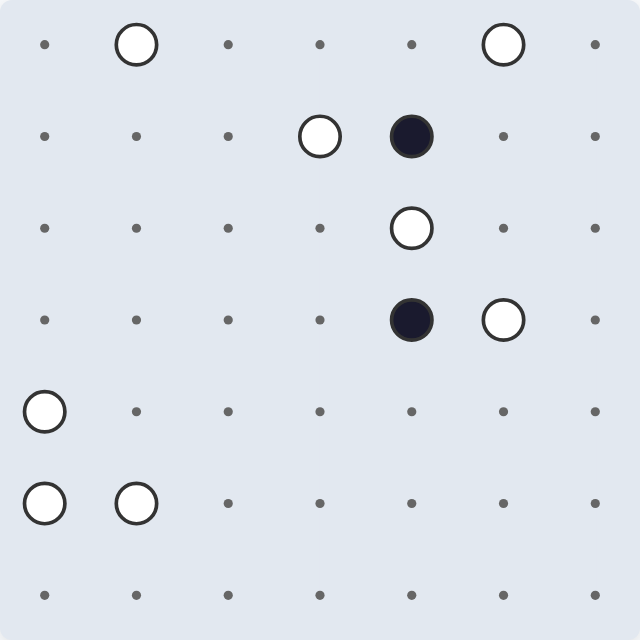
How to play Masyu
- Draw lines along the dotted grid edges until they trace one single closed loop: no dead ends, no branches, and no edge used twice.
- A white pearl requires the loop to run straight through that lattice point, and to turn at one or both of the points immediately next to it along that straight line.
- A black pearl requires the loop to turn at that lattice point, and to run straight through both of the points immediately next to it in the direction the loop continues.
- Marking an edge you have ruled out with an X (rather than leaving it blank) is optional bookkeeping: it never counts toward a pearl’s rule, but it helps you track deductions as the board fills in.
- The puzzle is solved the instant the drawn lines form exactly one closed loop and every pearl’s rule is satisfied; there is no separate submit step.
Controls (touchscreen)
- Tap an edge to draw a line on it; tap again to mark it with an X; tap a third time to clear it back to empty.
- Drag across several edges to draw or clear a whole run at once: the first edge your finger touches decides the value, and the rest of the drag matches it.
Controls (PC)
- Click an edge to draw a line on it; click again to mark it with an X; click again to clear it back to empty.
- Click and drag across several edges to draw or clear a whole run at once.
- Arrow keysUse the Arrow keys to move the highlighted edge cursor around the board.
- SpaceEnterPress Space or Enter to cycle the cursor’s edge through empty, line, and X.
- XPress X to mark the cursor’s edge with an X directly.
- CtrlZPress Ctrl+Z (Cmd+Z on Mac) to undo.
Every Masyu puzzle is fair
Masyu’s pearls are placed differently from Slitherlink’s numbers: they’re dug by a plain seeded removal, not checked against a solver for a second solution, so a generated board can honestly admit more than one loop that satisfies every pearl on it. That’s by design, not a flaw: the win check accepts any single closed loop that obeys every pearl’s straight-through or turn rule, not specifically the one the generator happened to draw first, so there is never a “wrong” correct answer.
Pearl density falls from 22% of lattice points at 5×5 down to 15% at 10×10, following the same denser-when-small pattern Slitherlink uses for its numbers. But where Slitherlink’s dig loop is gated by a search, Masyu’s is a flat seeded removal down to that floor, precisely because no search here could ever certify a pearl set unique in the first place.