Play Hex Loop Online
About Hex Loop
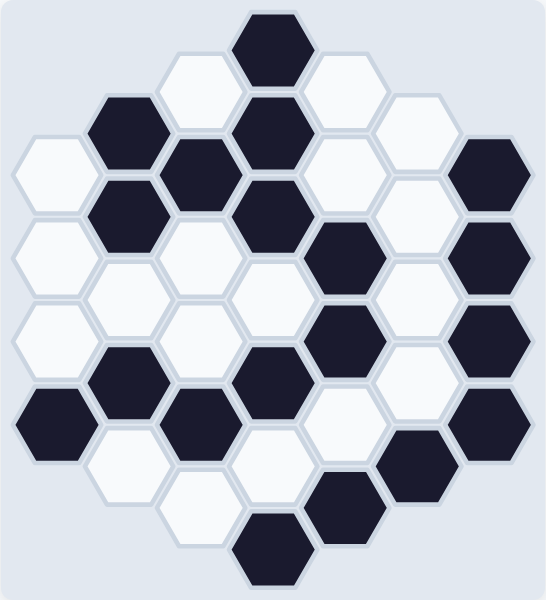
Hex Loop is played on a board of hexagonal cells arranged in concentric rings around a center hex. Dragging a continuous path across adjacent hexagons flips the color of every hex it touches. The goal is to find a path whose flips leave each concentric ring a single, uniform color: no ring may end up a mix of both colors.
Because every hex you visit flips, retracing part of your path undoes those flips rather than redoing them, which makes planning the route as important as picking the right hexes. Pick a board size above to start a new puzzle.
Board radius is what changes the reasoning here far more than it changes the rules: a small board's few rings settle with a handful of considered flips, but a wide board asks you to track how a single hex's flip can pull one ring toward matching while pushing an outer ring further from it, since one path touches multiple rings' worth of hexes at once. A ring near the center gets crossed by almost every long path you might draw, while an outer ring only answers to whichever route actually reaches that far out, so the outer rings are usually where a plan has to be committed to earliest.
How to play Hex Loop
- Drag a single continuous path through adjacent hexagons: every hex your path visits flips from one color to the other.
- The board is organized into concentric rings around the center hex; the puzzle is solved once every ring ends up entirely one color, with no ring left mixed between the two colors.
- Because retracing a step flips that hex back, your path's exact route matters, not just which hexes it eventually touches; visiting a hex twice cancels out, so an efficient path usually visits each hex it needs exactly once.
- Plan from the outer rings inward, or vice versa, rather than wandering hex by hex: committing to a ring's target color early tells you which of its hexes still need a flip.
- The puzzle is solved the instant every ring is uniformly one color; there's no separate confirmation step.
Controls (touchscreen)
- Touch a starting hex, then drag across adjacent hexes to extend your path one hex at a time.
- Drag back onto the previous hex in your path to retract your most recent step, undoing that flip.
- Press Reset to clear your path entirely and start over from the board's original colors.
Controls (PC)
- Click and drag from any starting hex onto adjacent hexes to draw the path.
- Drag back onto the previous hex to retract one step, undoing that flip.
- Click Reset to clear the path and return to the board's original colors.
Every Hex Loop puzzle is fair
Every Hex Loop board is guaranteed solvable by construction, not by chance: the generator builds the scramble by XOR-ing a walk's toggles onto an already-solved target, so retracing that exact walk always restores every ring to a single colour again. There's no hidden information and no random element inside a round: every hex's current colour is visible the whole time, so working out a path is entirely a matter of tracking which flips undo which, never a guess.
If sixteen seed-bumped attempts in a row all happen to land on an already-solved board, the generator gives up on drawing a fresh one and falls back to a hand-built striped pattern instead (still unsolved, still reachable by that same XOR construction, just no longer freshly random). That fallback has never been the common case; it exists as a backstop for the unlikely outcome, not the expected one.