Play Shikaku Online
About Shikaku
Shikaku (“division rectangles”) hands you a grid dotted with numbers and asks you to slice the whole board into rectangles, one per number, where each rectangle’s area (its width times its height) exactly equals the number it contains. There is no fixed shape for a given clue: a 6 could be a 1×6 strip, a 2×3 block, or a 3×2 block, and any of those is correct as long as it covers exactly six cells and holds exactly that one number.
Every board is generated fresh from a seed baked into the page URL, so a link always reopens the exact same puzzle. Pick a difficulty above to start (from a gentle 5×5 grid up to a demanding 15×15 board carrying larger, harder-to-spot rectangles).
A clue’s number constrains its rectangle’s shape less than you’d expect on its own (a 6 could be a 1×6 strip or a 2×3 block), so what actually narrows a Shikaku board down is how clues sit relative to each other: two clues close together often force a boundary neither could dictate alone. Larger boards don’t just add more rectangles, they add more of those forcing pairs stacked across a bigger grid, so a solve leans more on cross-referencing clues far apart from each other than on any single clue’s number.
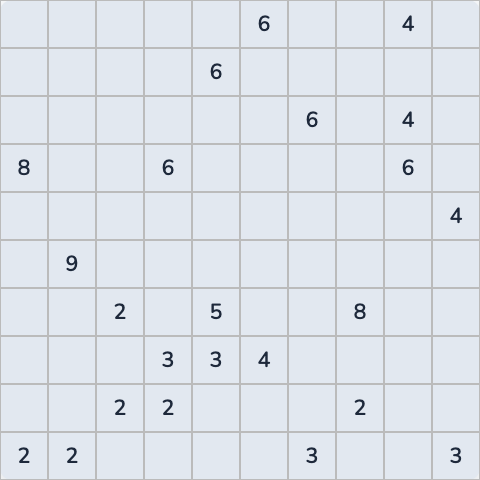
How to play Shikaku
- The board is a grid you must divide completely into rectangles: every cell belongs to exactly one rectangle, none is left uncovered, and no two rectangles overlap.
- Every rectangle holds exactly one number, and that number is its area: its width times its height, not its shape. A clue of 6 could be drawn as a 1×6 strip, a 2×3 block, a 3×2 block, or a 6×1 strip; any of those is correct as long as the rectangle covers exactly six cells and holds exactly that one clue.
- Drag from one corner of a rectangle to the opposite corner to draw it. Tap inside a rectangle already on the board to remove it, and dragging a new rectangle across one or more existing rectangles replaces all of them with the new one in a single move.
- A rectangle shows an error tint the moment it doesn't hold exactly one clue, or its area doesn't match the clue it does hold. The puzzle is solved the instant every cell is covered and every rectangle satisfies its own clue; there is no separate submit step.
Controls (touchscreen)
- Drag from one corner of a rectangle to the opposite corner to draw it.
- Tap inside a rectangle already on the board to remove it.
- Drag a new rectangle across one or more existing rectangles to replace all of them with the new one.
Controls (PC)
- Click and drag from one corner of a rectangle to the opposite corner to draw it.
- Click inside a rectangle already on the board to remove it.
- Drag a new rectangle across one or more existing rectangles to replace all of them with the new one.
- Arrow keysUse the Arrow keys to move the keyboard cursor around the board.
- SpaceEnterPress Space or Enter to drop an anchor at the cursor, then move the cursor and press Space or Enter again to draw the rectangle spanning the two.
- XPress X to remove the rectangle under the cursor.
- EscapePress Escape to cancel a pending anchor without drawing a rectangle.
- CtrlZPress Ctrl+Z (or Cmd+Z on Mac) to undo your last move.
Every Shikaku puzzle is fair
Every Shikaku board here ships only once countShikakuSolutions has proven its clue set pins the partition down to exactly one arrangement of rectangles: an inconclusive search, where the solver’s own node budget runs out before it can decide, is treated the same as “not unique” and never accepted. There is exactly one way to slice the board that satisfies every numbered clue, reachable by deduction alone.
When a clue draw fails to pin a partition down uniquely, the generator re-rolls just the clue cells on that same partition first (a cheap retry) before ever resplitting the board from scratch, since a fresh clue draw usually succeeds long before a fresh partition is needed. Every one of those retries is proof-gated the same way: an inconclusive count is never treated as evidence that a partition is safe to ship.