Play Nonogram Online
About Nonogram
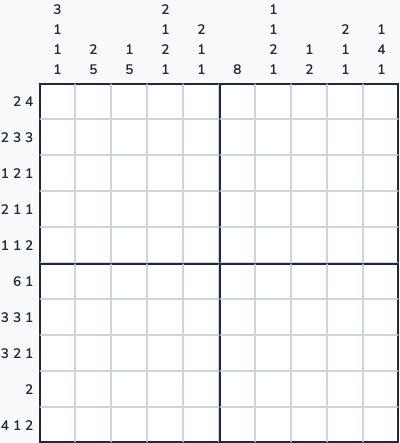
Nonograms (also called Picross or Griddlers) are picture logic puzzles: a grid with no picture visible, only a row of numbers beside each row and above each column. Each number is a clue about how many consecutive cells in that line should be filled in. Work out the right combination across every row and column, and a hidden picture emerges from the grid.
Because the clues are read directly off a real hidden picture rather than designed by hand, working through them logically will always lead you back to that exact picture. Pick a grid size above to start a new puzzle.
Board size is the only difficulty knob here (the 55% fill chance behind every hidden picture never changes), so what a bigger grid actually adds is more crossing lines to hold in your head at once: a 5×5 grid's clues interact directly within a handful of cells, while a 25×25 grid spreads that same kind of local reasoning across hundreds of intersections, and a wrong guess about one line can quietly seed a wrong deduction several rows away before you notice the numbers no longer add up.
How to play Nonogram
- Fill in cells so the filled cells in every row and column match that line's number clues exactly.
- Each clue number is the length of one consecutive run of filled cells in that line: a clue of 3 means three filled cells in a row, with a gap of at least one empty cell before the next run.
- When a line has several clue numbers, like "2 1 3", those runs appear in that order along the line, separated by at least one empty cell between each pair, but the exact spacing is for you to work out from the other lines crossing it.
- A clue of 0 simply means that entire row or column stays empty (useful as a starting anchor since there's nothing to figure out there).
- The puzzle is solved once every row and column's filled cells match its clues; at that point the hidden picture is fully revealed.
Controls (touchscreen)
- Tap a cell to cycle its state: unmarked, then filled, then explicitly marked empty, then back to unmarked.
- Long-press a cell to immediately reset it to unmarked, skipping the cycle.
Controls (PC)
- Left-click a cell to cycle its state: unmarked, then filled, then explicitly marked empty, then back to unmarked.
- Right-click a cell to immediately reset it to unmarked.
Every Nonogram puzzle is fair
Nonogram's clue numbers are read straight off the random picture the generator drew, but they're never checked for a single matching picture afterward: winning only compares the clue numbers your filled cells produce to the puzzle's own clues, so a different arrangement of filled cells that produces the exact same row and column counts wins just as validly as the picture the generator started from. The puzzle never rules out an alternate reading on purpose.
Nothing about a clue is invented after the fact, either: the generator reads run lengths directly off the same random grid its own fill rule produced, resetting its count at every empty cell and recording one final run length if a line ends on a filled streak instead of a break. That mechanical readout is why the numbers always describe a real, drawable picture, even though nobody designed that picture by hand.