Play Minesweeper Online
About Minesweeper
Minesweeper is a grid of hidden cells, some of which conceal mines. Revealing a safe cell uncovers a number telling you how many mines sit in its 8 surrounding cells: that's the only information you get, and it's enough to deduce the entire board if you read it carefully. Reveal every safe cell without ever clicking a mine, and you win.
The tension comes from working with incomplete information: early on you're often forced to take an educated guess, but as more numbers get revealed, the board narrows down to cells you can prove are safe or mined through pure logic. Pick a grid size above to start a new board.
Board size changes the character of the deduction more than how often you need to guess: with roughly the same share of cells mined at every size, a 9×9 board resolves quickly because each revealed number touches a large fraction of what's left, while a sprawling 36×18 Master board spreads that same density over hundreds more cells, so a single number's neighbourhood tells you proportionally less and a solid read usually depends on combining several overlapping numbers rather than any one in isolation.
The five sizes on this page run from a tight 9×9 up to that sprawling 36×18 Master board, and every one of them keeps mines at roughly the same one-in-eight density rather than packing them in tighter as the grid grows. A bigger board isn't a denser one, in other words: it's simply more surface area to read, with more numbers eventually available to cross-reference before you're ever forced into a genuine coin flip.
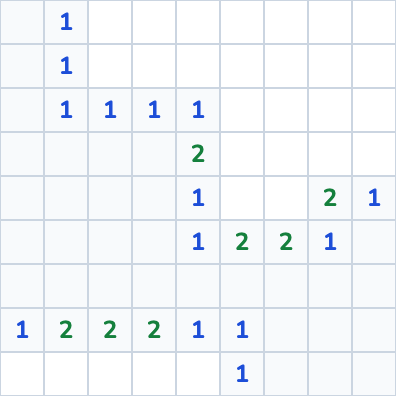
How to play Minesweeper
- Reveal every cell that does not contain a mine: that's the only way to win.
- Every board opens with one safe region already revealed, chosen from the puzzle's seed, so the same link always gives the same board and the same starting position.
- Each revealed number tells you exactly how many of its 8 neighboring cells contain mines, which is the core clue you'll use to work out where the rest of the mines are hiding.
- If you reveal a mine, the game ends immediately, so the goal is to only click cells you can either prove are safe, or are willing to gamble on when no certain move is available.
- Flag any cell you suspect contains a mine. Flags don't affect the board itself, but they help you keep track of your own deductions as the board fills in, especially on larger grids.
- You win the instant every safe cell has been revealed: the remaining, unrevealed cells are guaranteed to all be mines at that point.
Controls (touchscreen)
- Tap an unrevealed cell to reveal it.
- Long-press an unrevealed cell to place a flag on it; long-press again to remove the flag.
Controls (PC)
- Left-click an unrevealed cell to reveal it.
- Right-click an unrevealed cell to place a flag; right-click again to remove it.
Every Minesweeper puzzle is fair
Minesweeper doesn't promise a guess-free board the way this site's logic-grid puzzles do: the opening region is guaranteed safe, but once the easy deductions run out, a board can leave you with no cell provably safe or mined, and clearing it means picking the best odds you can read off the surrounding numbers rather than a certain move. That's the genuine shape of the game, not a flaw in how the board is built: a board that never required a guess would no longer be Minesweeper. Flags are optional bookkeeping rather than a requirement, too: the board only checks whether every non-mine cell has been revealed, so a full clear needs no flags at all, and placing one is purely a memory aid for a guess you're about to commit to.