Play Slide Out Online
About Slide Out
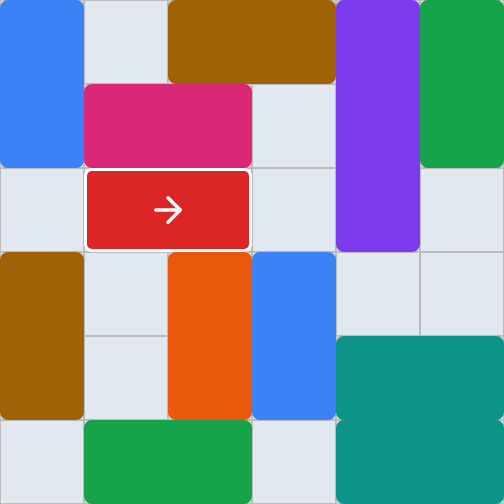
Slide Out is a gridlocked-traffic puzzle. Every car on the 6×6 board is locked to its own row or column: a horizontal car slides only left and right, a vertical car only up and down. One car (drawn in red, outlined, and carrying an arrow that points the way out) has to reach the notch cut into the board's right edge. Every other car is in the way somewhere, and the only way to move it is to slide it along its own row or column into a free space, clearing a path for the next car, and eventually the target.
Every board is generated fresh from a random seed, so the seed lives in the page URL and you can bookmark or share a specific board and come back to the exact same layout later. Four difficulties raise both the number of cars on the board (8 on Easy up to 14 on Expert) and the par band: Easy boards solve in 4-6 moves, Normal in 7-9, Hard in 10-12, and Expert in 13 or more.
What changes most across difficulties isn't the board size (every board here is 6×6) but how many cars are competing for the same lanes: Easy's 8 cars leave enough open space that a car often has a direct path once one blocker moves, while Expert's 14 cars mean clearing a path for the target usually means clearing a path for the car in its way first, and the car in that car's way before it. The par band existing at all just means that chain of dependencies is measured, not guessed at.
How to play Slide Out
- Every car on the board is locked to its own row or column. A horizontal car can only slide left or right along its row, and a vertical car can only slide up or down along its column. One car (drawn in red, outlined, and marked with an arrow pointing the way out) is the target: slide it right until it reaches the notch cut into the board's right edge.
- A slide can carry a car any distance in one motion: one slide of any length counts as one move, not one move per cell. But a car always stops the instant it reaches the wall or the next car in its lane; you cannot slide it through another car.
- Clear the target's path by sliding the cars blocking its row out of the way first (into their own free columns), then slide the target itself the rest of the way to the notch.
- Par is the exact minimum number of moves a solver found for this board, not an estimate. Beat the clock, then come back and try to match Par exactly.
Controls (touchscreen)
- Press and drag a car along its own row or column to slide it. It follows your finger along that lane and cannot pass the wall or the next car.
- Drag the arrow-marked red car all the way to the notch on the right edge to win.
Controls (PC)
- Click and drag a car along its own row or column to slide it. It follows your cursor along that lane and cannot pass the wall or the next car.
- Drag the arrow-marked red car all the way to the notch on the right edge to win.
- ,.Press , or . to select the previous or next car.
- Arrow keysUse the Arrow keys to slide the selected car along its own axis.
- CtrlZPress Ctrl+Z (or Cmd+Z on Mac) to undo your last move.
Every Slide Out puzzle is fair
Slide Out ships a proven answer for how hard a board is, not an estimate: shortestSlideSolution runs a breadth-first search over every reachable arrangement of every car before a layout is accepted, and only a layout whose exact minimum move count falls in the difficulty's band ships. There's no guessing at how many moves a board should take: the number posted as Par is the very count the generator checked, and replaying that exact sequence through the board always reaches the win in that many moves and not one fewer.
Landing in a difficulty's band isn't a tuning knob applied after the fact: it's why layouts are sampled and discarded in a loop until one lands in range, sometimes many times over on the higher difficulties. A non-target horizontal car is also never allowed to sit on the exit row in the first place, since it could never leave the target's own lane and the board would be unsolvable no matter how the other cars moved.