Play Shape Fit Online
About Shape Fit
Shape Fit is a polyomino-packing puzzle. The board shows a highlighted silhouette (one connected shape on Easy and Normal boards, two separate shapes on Hard, Expert and Master) and a gallery of pieces to fill it. Drag pieces from the gallery onto the board, rotating as needed, until the silhouette is exactly covered: every cell inside it filled, nothing spilling outside it.
Every board here is generated fresh from a random seed, so the seed lives in the page URL and you can bookmark or share a specific puzzle and return to the exact same board later. Pick a difficulty above (from a gentle 7×7 up to a demanding 15×15 with decoy pieces mixed into the gallery) to start.
The decoy count and chunk split are what change the thinking as difficulty rises, more than the board’s size: a single-chunk Easy board keeps just one decoy in the gallery, and that count climbs tier by tier (2 on Normal, 3 on Hard, 4 on Expert, 5 on Master), while Hard, Expert, and Master additionally split the silhouette into two separate shapes, so ruling a piece out becomes as important as finding where one belongs. Every decoy is a piece the generator did not use to build the silhouette, not one that could never fit it. A compact silhouette also forces fewer long, one-cell-wide runs, which is where a single piece shape is often the only one that fits.
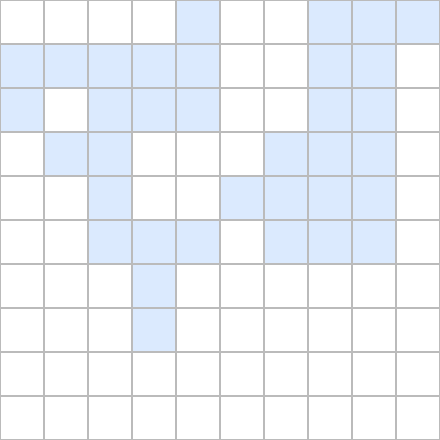
How to play Shape Fit
- The board holds one silhouette (two on Hard, Expert and Master), and the gallery holds the pieces that fill it, plus decoy pieces on every difficulty (one on Easy, two on Normal, three on Hard, four on Expert, five on Master), not part of the arrangement the generator built, though any exact cover still wins.
- Drag a piece from the gallery onto the board and rotate it in 90° steps until it fits. A dropped piece can land anywhere on the board that is in bounds; cells outside the silhouette still accept the piece but show an error tint so you can see what needs to move.
- You can drag a piece that is already on the board to reposition it, or drag it back off the board to return it to the gallery.
- The puzzle is solved the instant the covered cells exactly match the silhouette: every silhouette cell filled and nothing filled outside it. Leftover unplaced pieces, including every decoy, do not stop a win.
Controls (touchscreen)
- Drag a piece from the gallery onto the board to place it.
- While dragging, tap the board with a second finger to rotate the held piece 90°.
- Drop the piece anywhere in bounds: cells outside the silhouette accept the drop but show an error tint.
- Drag a piece already on the board to move it, or drag it off the board to send it back to the gallery.
Controls (PC)
- Click and drag a piece from the gallery onto the board to place it.
- While dragging, right-click to rotate the held piece 90°.
- Drop the piece anywhere in bounds: cells outside the silhouette accept the drop but show an error tint.
- Drag a piece already on the board to move it, or drag it off the board to return it to the gallery.
- SpaceEnterPick up the first unplaced piece.
- ,.Cycle through pieces.
- Arrow keysMove the held piece.
- RRotate the held piece 90°.
- EnterPlace the held piece.
- XRemove whatever piece is under the keyboard cursor.
- EscapeCancel the pickup: a piece taken from the gallery goes back, a placed piece stays put.
- CtrlZUndo your last move (Cmd+Z on Mac).
Every Shape Fit puzzle is fair
Shape Fit’s board is solvable by construction (the pieces used to build each silhouette are exactly the pieces you need to place), but the win check only ever compares the covered cells to the silhouette, never to the generator’s own arrangement. So whenever the piece catalog offers a different combination of shapes that also covers the silhouette exactly, that combination wins just as validly; there is no single “correct” set of pieces to find.
Decoys are drawn from the exact same size-filtered catalog as the real pieces, under the same two-copy cap that spans both, so a decoy is never a shape that couldn’t otherwise have appeared in the gallery honestly. If a decoy also happens to complete an alternate cover of the silhouette, that cover simply wins too: nothing about a decoy is flagged or excluded from counting as a legitimate solve.