Play Sliding Number Online
About Sliding Number
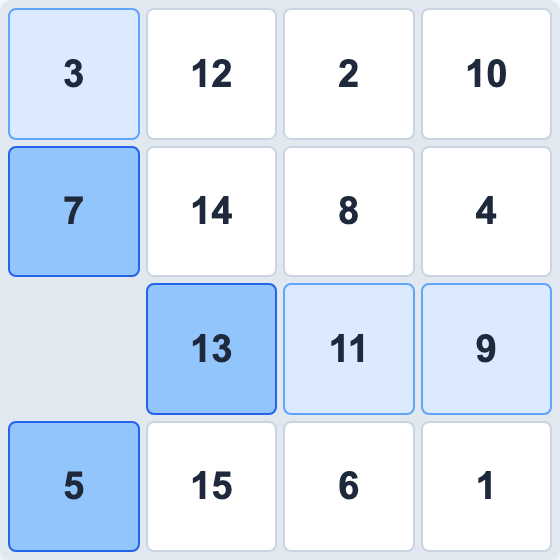
The Sliding Number puzzle (also known as the 15 puzzle in its classic 4×4 form) is one of the oldest sliding-tile puzzles around. Numbered tiles sit in a grid with one empty space; sliding tiles into that gap, one at a time, is the only move available. The goal is to return every tile to numerical order, reading left to right and top to bottom, with the empty space ending up in the bottom-right corner.
Despite the simple rule set, the puzzle can take a surprising number of moves to untangle, especially at larger grid sizes: every move you make changes which tiles are reachable next, so planning a few slides ahead pays off. Pick a grid size above to start a new shuffle.
Size changes what kind of thinking a Sliding Number puzzle asks for more than it changes the puzzle's rules: a 3×3 board has so few tiles that most moves are locally reversible, but a 9×9 board makes the last few tiles in a row or column dramatically harder to seat without disturbing tiles you already placed, since a large grid leaves far more of the board still mobile behind wherever you're currently working. The classic trick of solving a grid a row and a column at a time, saving the last two cells of each for a short rotation, is what that difficulty curve rewards.
How to play Sliding Number
- Arrange the numbered tiles in order from left to right, top to bottom (1, 2, 3 and so on), with the empty space ending up in the bottom-right corner.
- Only a tile that shares a row or column with the empty space can move, and it always slides directly into that gap.
- Because each slide just swaps a tile with the empty space, every move you make is reversible: the puzzle never traps you in an unsolvable position, but it can take many moves to walk a single tile to where it belongs.
- A common approach is to solve the top row and left column first, then work inward on the smaller remaining grid (the same technique used to solve larger Rubik's-Cube-style puzzles a layer at a time).
- The puzzle is solved the instant every tile lands in the correct order; there's no separate confirmation step.
Controls (touchscreen)
- Tap any tile that shares a row or column with the empty space to slide that entire line (every tile between the one you tapped and the gap) one step toward the gap.
Controls (PC)
- Arrow keysPress an Arrow key to slide the row or column adjacent to the empty space in that direction.
- Alternatively, click a tile in the same row or column as the empty space to slide it the same way a tap would.
Every Sliding Number puzzle is fair
Every Sliding Number board is scrambled from the solved arrangement by a long run of legal slides, which is what guarantees it's solvable at all: half of all tile arrangements can never be solved, and building a board forward from a random layout would risk shipping exactly one of those. Solving one back to order never depends on luck: every move is fully visible on the board, and any position the scramble can reach can always be reasoned all the way back to solved.
Every scramble move is drawn from whichever tiles are legally slidable at that moment, with one exception: the position the empty space just came from is removed from consideration first, so a long scramble can't quietly cancel itself out by sliding the same tile back and forth. That's the only rule guiding the shuffle: no size gets special treatment, so a 3×3 and a 9×9 board are scrambled by exactly the same process, just for far longer on the bigger grid.