Play Memory Pairs Online
About Memory Pairs
Memory Pairs is a classic matching-cards puzzle. Every card starts face down; flip two a turn hunting for a pair that shows the same picture. A match locks in place, a mismatch turns back over on your next flip, and the board is solved once every card is locked.
Every board here is generated fresh from a random seed, so the seed lives in the page URL and you can bookmark or share a specific puzzle and return to the exact same layout later. Pick a size above (from a quick 4×4 up to a demanding 8×8) to start.
Board shape matters here as much as board size: 4×6 and 6×8 are rectangular specifically because an odd cell count can’t pair up evenly, and a wider board spreads matching icons further apart, which is what actually drives difficulty rather than the pair count alone: a compact 4×4 keeps every card close enough that a recent mismatch is easy to hold onto, while an 8×8 board asks you to carry several unmatched icons in mind at once across a much longer distance between flips.
Each size also carries its own difficulty label, and the pair count behind that label climbs a clear step at a time: 4×4 is Easy at 8 pairs, 4×6 is Normal at 12, 6×6 is Hard at 18, 6×8 is Expert at 24, and 8×8 is Master at the full 32. That progression means every rung up adds a meaningful block of new pairs to hold in mind rather than just a couple of extra cells tacked onto the same board: the jump from Hard to Expert alone adds six more pairs to track at once, on top of the wider spread Expert’s rectangular shape already demands.
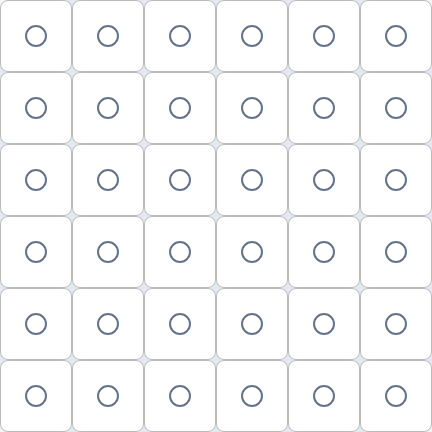
How to play Memory Pairs
- Every card starts face down. Flip two cards a turn, hunting for two that show the same picture.
- The first card you flip in a turn just reveals itself: nothing is judged until a second card joins it.
- Flip a matching second card and both lock face up for the rest of the game. Flip a different picture instead and both stay face up only until your next flip, which turns them back down.
- The puzzle is solved the instant every card on the board is locked; there is no separate submit step.
- Your move count only rises on the second card of a turn, so studying a single flip freely costs nothing.
Controls (touchscreen)
- Tap a face-down card to flip it. Flip a second card to complete the turn.
Controls (PC)
- Click a face-down card to flip it. Click a second card to complete the turn.
- Arrow keysUse the Arrow keys to move the highlighted card cursor around the board.
- SpaceEnterPress Space or Enter to flip the cursor’s card.
Every Memory Pairs puzzle is fair
Every Memory Pairs layout is solvable by construction (flipping every remaining pair in sequence always finishes the board), but there’s no single correct order to find the matches in: any sequence of flips that eventually pairs up every card counts as a full solve, so two players clearing the same board can take entirely different, equally valid paths to the end. What decides how well you did is how few extra flips your memory cost you, not which pair you happened to find first.
The engine draws every board’s icons from a single 32-face catalogue, fresh each time, so a 4×4 board and an 8×8 board never share a guaranteed set of pictures: a small board might draw an entirely different subset from a large one on the very next seed. That catalogue size is also the hard ceiling on how big a board can get: 8×8 uses all 32 icons at once, as far as the format can go without repeating an identity within a single board.
The move counter that scores a finished board only rises once a turn is complete, not on every card you touch: turning over the first card of a turn is free, and the tally ticks up when the second card lands, whether the two match or not. That means testing a card you are only half sure about costs exactly as much as flipping one you already knew was safe, so there is no separate penalty for a calculated guess versus a confirmed match. A matched pair locks in place the instant the second card confirms it (a turn is always exactly two cards, never three), and once a pair is locked it stays face up and out of play for the rest of that board, so nothing you have already solved can ever come back to cost you another flip.